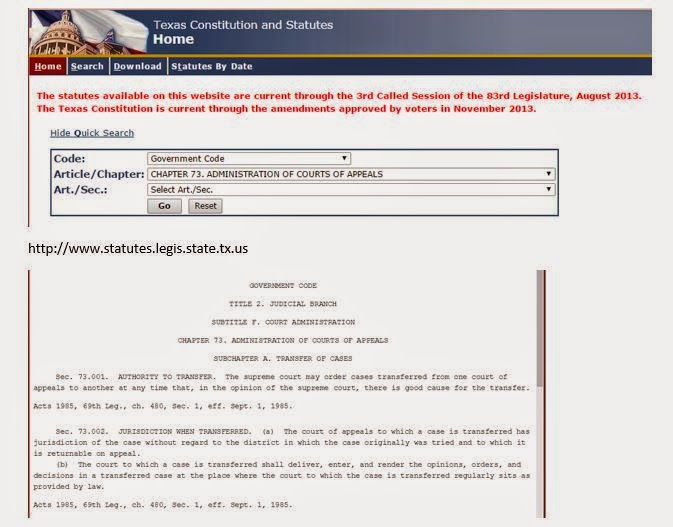
TEXAS SUPREME COURT TRANSFERS CASES AMONG THE INTERMEDIATE COURTS TO EVEN OUT THE DOCKETS, BUT THIS CAN CREATE A CONUNDRUM WHEN THE INTERMEDIATE COURTS ARE SPLIT ON AN UNSETTLED LEGAL ISSUE
Transfer of cases among the courts of appeals combined with the rule that they be decided based on the precedents of the transferring court (officially called the "transferor court") represents yet another wrinkle in what even some justices acknowledge is a byzantine court system in Texas.
See, e.g., Texas Supreme Court Justice
Willett's Dissent in In re Reece, 341 SW 3d 360 (Tex. 2011).
The recent decisions of the Corpus Christi and Eastland Courts of Appeals in three credit card debt cases -- all transferred from the
Second Court of Appeals in Fort Worth -- provide an apt illustration that
docket equalization can be more than a merely administrative matter. Case transfers can have significant ramifications for the evolution of the common law as articulated through the decisions of the intermediate courts when the there is no controlling authority from the state's highest court.
- Rose Core v. Citibank (South Dakota, N.A.) No. 11-13-00040-CV (Tex.App.- Eastland [11th Dist.] February 27, 2015, motion for rehearing filed)(Op by Justice John M. Bailey)(case transferred from Second Court of Appeals in Fort Worth). Trial court: 362nd District Court in Denton County (Judge Bruce McFarling).
- Marc R. Core v. Citibank, N.A., No. 13-12-00648-CV (Tex.App.- Corpus Christi, Edinburg [13th Dist.], April 9, 2015, no pet h.) (Opinion by Justice Rodriguez)(also on transfer from 2nd COA in Fort Worth). Trial court: 211th District Court in Denton County (Judge Lawrence Dee Shipman).
- Scott Walker v. Citibank, N.A. No. 11-13-00042-CV (Tex.App.- Eastland [11th Dist.], Feb. 27, 2015, pet. to be filed under Cause No. 15-0287 (Op. by retired Justice Terry McCall, sitting by assignment) (case transferred from the 2nd Court of Appeals) Trial court: 342nd District Court in Tarrant County (Judge J. Wade Birdwell).
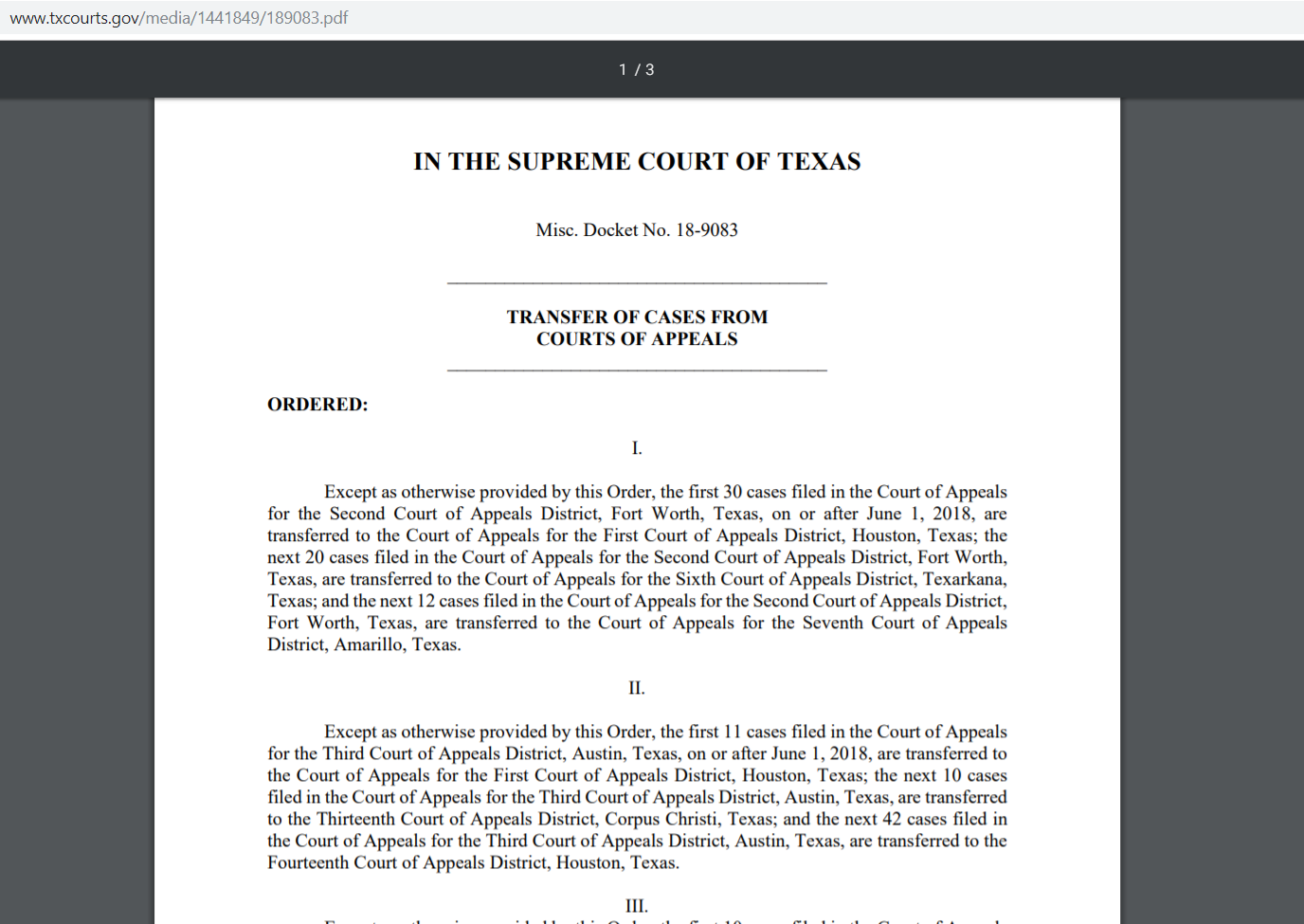
All three were were transferred from the Second Court of Appeals in Fort Worth, but not to the same sister court.
Marc R. Core v Citibank went to the
Corpus Christi Court of Appeals, while the other two (
Rose Core v Citibank and
Scott Walker v Citibank) went to
Eastland. One of the case had been appealed from Tarrant County (Fort Worth), while the other two originated in Denton County.
Both receiving courts were obligated to apply the caselaw of the Fort Worth Court of Appeals, rather than their own, but the state of the case law on the legal issue raised on those cases -- the viability of the account stated theory in the context of a defaulted credit card account, and the associated proof requirements -- was not entirely clear based on prior decisions of that court, not to mention settled.
PRIOR FORT WORTH CASE ON "ACCOUNT STATED" CLAIM BY CITIBANK
There were two prior cases from the Fort Worth-based court, but neither of them "published" (i.e.
published in the South Western Reporter), and in a prior case involving Citibank, the Fort Worth-based court of appeals had ruled that Citibank had not proven its case under the applicable evidentiary standard, and had accordingly reversed the judgment granted in the bank's favor. The court remanded for a new trial.
See Morrison v. Citibank (South Dakota), N.A., 2008 W.L. 553284, 2008 Tex. App. Lexis 1692 (Tex. App. - Fort Worth 2008, no pet.) (mem. op.) (per curiam).
In
Morrison, the Fort Worth-based court stated:
Assuming without deciding that account stated may be employed to collect credit card debt under Texas law, we nevertheless conclude that the evidence is too weak to support the trial court's judgment.
The court resolved the consumer's appeal of the judgment in favor of Citibank on sufficiency-of-evidence grounds and expressly declined to say whether it accepted account stated as a viable theory of recovery for credit card debt. The review was for factual sufficiency because the underlying judgment was entered after a bench trial.
In all the appellate cases involving the account-stated theory in the credit card debt context decided by other Texas courts of appeals, the creditor had won, and in most of these cases the creditor was Citibank. The bank was represented by the very same attorneys that also created the new precedent in Dallas upon which these cases rely as authority:
Dulong v. Citibank (South Dakota), N.A., 261 S.W.3d 890 (Tex. App.–Dallas 2008, no pet.). Thus, the bank was in a position to cite its own prior ligation victories as legal authority. See -->
The Citibank Doctrine: Account Stated for Credit Card Debt Collection.
In
Dulong, the Dallas Court of Appeals modified then-existing caselaw governing account-stated by approving it as a viable theory of collection of a financial debt incurred with a bank (as opposed to a debt incurred through purchase of goods or rendition and acceptance of services).
In subsequent cases, it stuck to its novel interpretation of the suit on account theory, and in one of those subsequent cases it overtly expressed its disagreement with the Fort Worth court's holding in
Morrison, which was most directly on point in a case involving the same plaintiff.
See Compton v. Citibank (S.D.), N.A., 364 S.W.3d 415, 419–20 (Tex. App.—Dallas 2012, no pet.) (
citing Dulong, 261 S.W.3d at 894). On multiple occasion since, the Dallas court has cited its novel precedent for the proposition that Citibank was exempted from having to prove the underlying contract if it sought judgment on account stated, which only required proof of an agreement on the amount, rather than on credit terms, and held that such an agreement on the amount could be implied, i.e. it did not have to be articulated.
Both courts that heard the three Citibank account-stated cases transferred from Fort Worth ended up distinguishing the
Morrison case decided by that court, and ended up following the Dallas Court of Appeals. They did so notwithstanding the express split between the Second and the Fifth, and the Dallas court's express rejection of the holding of the sister court in Fort Worth.
COURT OF APPEALS' SPAT OVER CITIBANK'S THEORY: DALLAS VS. FORT WORTH
The Dallas court was adamant about not having to follow the prior decisions of a sister court, and was on solid ground in taking that position in the absence of binding Texas Supreme Court precedent. The transferree courts, by contrast, were required to follow the precedents of the transferor court.
Significantly, in the prior case in which Citibank had pushed its revamped account-stated theory in the Fort Worth Court of Appeals -
Morrison v Citibank -- it had failed, and that was the very case that the Dallas Court of Appeals took issue with in
Compton.
Did the transferree courts acknowledge taking sides with Dallas in the Metroplex split?
In
Marc Core v Citibank, the Thirteenth Court of Appeals acknowledged the dicey issue of precedent in a footnote, pointing out that
Morrison was just a memorandum opinion, but also distinguished the cases on the facts. In the
Morrison case, ten accounts were involved in a single lawsuit while in both
Core v Citibank cases there was only one each. ("Factually, this appeal only involves a single credit card account.", at p. 16). But that seems a lame distinction, for the law would be identical regardless of whether there is only one account or several.
The distinction of Morrison on the basis that it involved reversal of a judgment rendered after a bench trial (at p. 16) sounds equally hollow, because the evidentiary standard for entitlement to summary judgment (in
Core v Citibank) was higher, not lower. In
Core, Citibank had to prove all substantive elements of its cause of action conclusively, while in
Morrison - which involved resolution of all issues in a trial to the bench -- it only had to prove each element under the preponderance-of-the-evidence standard. Additionally, factual discrepancies and conflicts in the evidence can be resolved by the fact finder at trial, while they preclude summary disposition if they concern material issues of fact in the summary judgment context.
As for the issue whether
Morrison was binding on it, the Corpus Christi court said the following about the Fort Worth court's opinion:
The fact that Morrison v. Citibank (South Dakota), N.A., is a memorandum opinion from the Second Court of Appeals is significant because this case was transferred to us from the Second Court of Appeals in Fort Worth pursuant to an order of the Texas Supreme Court under the authority of section 73.001 of the Texas Government Code. See No. 2-07-00130-CV, 2008 WL 553284, at *1–3 (Tex. App.—Fort Worth Feb. 28, 2008, no pet.) (mem. op.) (per curiam); see also TEX. GOV’T CODE ANN. § 73.001. In accordance with rule 41.3 of the Texas Rules of Appellate Procedure, we are required to follow the precedent of the Fort Worth Court of Appeals “unless it appears that the transferor court itself would not be bound by that precedent.” TEX. R. APP. P. 41.3.
The jurisprudentially most significant issue in all of these cases --
transferred or otherwise -- is the legal issue of
whether account stated is a proper theory for collection of a financial debt owned to a bank, rather than to a merchant and seller of goods or services.
Although the Corpus-based court cites
Morrison v Citibank for the elements of account stated (along with recent cases from other courts including
Dulong), the Fort Worth Court of Appeals had reserved judgment on that issue.
A DOCTRINAL QUESTION, NOT MERELY ONE OF EVIDENTIARY SUFFICIENCY
The matter of whether "account stated" can serve as an alternative legal theory to breach of contract in a suit to recover a credit card debt, which is necessary based on a contract because statutory law requires it, is a quintessential matter of substantive law, rather than merely one of fact and sufficiency of the evidence, although the nature of the theory obviously also dictates the type or proof needed to satisfy its essential elements.
In
Morrison, the Fort Worth Court of Appeals stated:
Assuming without deciding that account stated may be employed to collect credit card debt under Texas law, we nevertheless conclude that the evidence is too weak to support the trial court's judgment.
The Fort Worth Court of Appeals thus resolved Morrison's appeal of the judgment in favor of Citibank on factual sufficiency grounds and expressly declined to determine whether it accepted account stated as a viable theory of recovery for credit card debt.
It also pointed out, citing
Neil v. Agris, 693 S.W.2d 604 (Tex.App.-Houston [14th Dist.] 1985, no writ), which the Dallas Count had also cited in
Dulong, that Citibank had not established the reasonableness of the price in the absence of an agreement:
[Affiant] Guenther did not testify that the prices charged were usual, customary, and reasonable, a potential alternative to proving the second element. See Neil, 693 S.W.2d at 605.
In other words, the Fort Worth Court of Appeals adhered to the precedents pre-dating the Dallas Court's
Dulong decision. It relied on the case law that treats
account stated and
open account as claims arising from transactions involving the sale of goods or services by merchants. Under those theories, the plaintiff has the burden to prove that it provided goods or services, and the price/charges were either agreed to by the parties, or were customary and reasonable as established by other evidence, absent an agreement.
Those requirements still apply in a suit on sworn account when the petition does not strictly conform with the requirements of Rule 185, or when the Defendant files a sworn denial and thus neutralizes the evidentiary benefits of Rule 185. -->
Credit card debt suit cannot be brought as a sworn-account.
CAN ONE COURT OF APPEALS SET BINDING PRECEDENT FOR ANOTHER?
It is probably fair to say that the courts in Corpus Christi and Eastland were not bound by
Morrison, and that they did establish the precedent that the Fort Worth court was not prepared to set in
Morrison, even though the Fort Worth court could have done so, -- one way or the other.
Does that mean that the Fort Worth court is bound by the holding of the Thirteenth and Eleventh Courts of Appeals regarding account stated as a proper theory for credit card debt collection in the transferred case? Apparently so.
But will the Fort Worth court accept the legitimacy of another court acting in its stead when the court had chosen not to decide whether a credit card debt collection case is properly brought as an "account stated" claim, and had save that issue for another day? Particularly when considering that the
Dulong case, on which the subsequent account-stated cases rely as authority, is doctrinally flawed and creates conflict with long-standing caselaw on open account and account stated outside the context of credit card debt collection.
It remains to be seen.
CASES INVOLVING ACCOUNT STATED IN THE CREDIT CARD DEBT CONTEXT
CORPUS CHRISTI COURT OF APPEALS (ON TRANSFER FROM FORT WORTH)
[Marc]
Core v. Citibank, N.A., No.
13-12-00648-CV (Tex.App.- Corpus Christi, Edinburg [13th Dist.], April 9, 2015, no pet h.) (Opinion by Justice Rodriguez)
EASTLAND COURT OF APPEALS (ON TRANSFER FROM FORT WORTH)
[Rose]
Core v. Citibank (S.D.), N.A., now known as Citibank, N.A., No.
11-13-00040-CV (Tex.App.- Eastland [11th Dist.] February 27, 2015, motion for rehearing filed )(Op by Justice John M. Bailey)(case transferred from
Second Court of Appeals in Fort Worth)
Walker v. Citibank, N.A., No.
11-13-00042-CV, 2015 WL 1004395, at *3 (Tex.App.- Eastland [11th Dist.], Feb. 27, 2015) (Op. by retired Justice Terry McCall, sitting by assignment) (case transferred from the 2nd Court of Appeals) (concluding that “an account[-]stated cause of action is appropriate for a suit to collect credit card debt” and setting out the elements of an account-stated claim)
FORT WORTH COURT OF APPEALS
Morrison v. Citibank (S.D.) N.A., No.
02-07-00130-CV, 2008 WL 553284, at *1 (Tex. App.—Fort Worth Feb. 28, 2008, no pet.) (mem. op.) (per curiam) (judgment in favor of Citibank on account stated theory reversed in suit involving ten credit card accounts).
DALLAS COURT OF APPEALS
DuLong v. Citibank (S.D.), N.A., 261 S.W.3d 890, 893 (Tex. App.—Dallas 2008, no pet.)
Compton v. Citibank (S.D.), N.A., 364 S.W.3d 415, 419–20 (Tex. App.—Dallas 2012, no pet.) (citing
DuLong, 261 S.W.3d at 894)(follow-up case stating disagreement with Fort Worth court's opinion in Morrison).
Hays v. Citibank (S.D.), N.A., No. 05-11-00187-CV, 2012 WL 929673 (Tex.App.-Dallas Mar. 16, 2012, no pet. h.) (mem. op.)
Owusu v. Citibank (S.D.), N.A., No. 05-10-00175-CV, 2011 WL 2465475 (Tex.App.-Dallas June 22, 2011, no pet.) (mem. op.)
Moir v. Citibank (S.D.), N.A., No. 05-09-00641-CV, 2010 WL 2574212 (Tex. App.-Dallas June 29, 2010, no pet.) (mem. op.)
AUSTIN COURT OF APPEALS
Singh v. Citibank (S.D.), N.A., 03-10-00408-CV, 2011 WL 1103788 (Tex.App.-Austin Mar. 24, 2011, no pet.) (mem. op.)
Damron v. Citibank (S.D.), N.A., No. 03-09-00438-CV, 2010 WL 3377777 (Tex.App.-Austin Aug. 25, 2010, pet. denied) (mem. op.)
SAN ANTONIO COURT OF APPEALS
Rodriguez v. Citibank, N.A., No. 04-12-00777-CV, 2013 WL 4682194 (Tex. App.—San Antonio Aug. 30, 2013, no pet.) (mem. op.)
WACO COURT OF APPEALS
McGrew v. Citibank (S.D.), N.A., No. 10-07-00343-CV, 2009 WL 1693473 (Tex.App.-Waco 2009, no pet.) (mem. op.)
HOUSTON COURT OF APPEALS
Busch v. Hudson & Keyse, LLC, 312 S.W.3d 294, 299 (Tex. App.—Houston [14th
Dist.] 2010, no pet.)
EL PASO COURT OF APPEALS
Eaves v. Unifund CCR Partners, 301 S.W.3d 402 (Tex. App.—El Paso 2009, no pet.)


%2C%2BN.A.%2B-%2BCase%2Bstyle.JPG)