Showing posts with label appellate-statistics. Show all posts

Sunday, March 15, 2015

Appellate Caseloads in the Texas Courts of Appeals - Comparative Data from the 2014 Statistical Report


ANNUAL STATS ON ACTIVITY BY THE INTERMEDIATE COURTS OF APPEALS 
FISCAL YEAR 2014 (2013-2014) 

Due to space limitations, not all of the data collected and made available by the Office of Court Administration can be included in its annual report. Additional data can be accessed and downloaded on the agency's webpage, however. The table below was included in the most recent report and presents a comparative overview of cases filed and processed by each court of appeals.

The remainder of the blog provides info on where to find statistical information on opinion writing by individual justices on each court that reflects their respective productivity, and the amount of agreement and disagreement with their peers on the same court, as reflected in the incidence of concurring and dissenting opinions.

SOURCE: Annual Statistical Report for the Texas Judiciary for Fiscal Year 2014 

DRILL-DOWN AND GREATER DETAIL ON NUMBER AND TYPES OF OPINIONS AUTHORED BY INDIVIDUAL JUSTICES 

Opinion production stats broken down by court and individual members of each courts are also available from the Office of Court Administration (OCA), though not published in the Annual Statistical Report.

The more detailed information includes the following: 

  • Activity Detail
  • Opinion Summary
  • Appeals by County

The last three data collections  - Activity Detail, Opinion Summary, and Appeals by County -- are in the form of downloadable spreadsheets.

Tables for each appellate court showing opinion authorship by justice (which are derived from the spreadsheet data files referenced above) can be found on the CoA-specific pages of this blawg (click hyperlink for each CoA in the masthead above).

Questions addressed by this blog post: How many cases do the Texas Courts of Appeals decide per year. Where can I find statistics on cases heard by the courts of appeals? How many cases are appealed in Texas? Where can I find information on the number of appellate cases decided by the intermediate courts of appeals in Texas? Statistics on the appellate court system in Texas.




Tuesday, March 10, 2015

Docket Equalization by the Texas Supreme Court by Transferring Cases


TRANSFER OF CASES FROM ONE TEXAS COURT OF APPEALS TO ANOTHER 

The fourteen intermediate courts of appeals in Texas vary in size between 3 and 13, but do not receive appeals in exact proportion to their share of the total number of justices statewide, which is 80. As a result, some courts of appeals end up with more cases per member than others. To meliorate the disproportionality, and to even the case-load burden, the Texas Supreme Court transfers batches of cases from courts of appeals with an excess of cases to those that are less busy.

The Supreme Court does this several times a year with administrative orders called docket-equalization orders. See TEX. GOV'T CODE ANN. § 73.001.

The cases that are transferred are not screened for the issues they raise, but are transferred based on date and filing sequence. The guiding rational is administrative convenience and efficiency in utilization of judicial resources.

The chart below shows the extent of disproportion, and the effect of equalization for Fiscal Year 2014. 
Number of Appeals filed by Justice before and after transfers (FY 2014 Chart)
New Filings Per Justice including and excluding transfers  
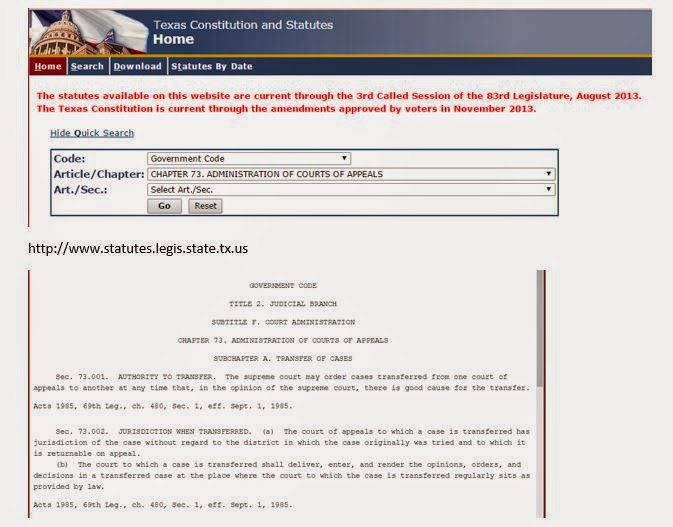
STATUTORY AUTHORITY FOR TRANSFER OF APPEALS AMONG THE COAs


Texas Government Code §73.001 


SAMPLE DOCKET EQUALIZATION ORDER 

http://www.txcourts.gov/media/824209/159022.pdf
Link to the full-length document 
  
 CASELAW SNIPPETS ON TRANSFER OF CASES 

The Texas Supreme Court transferred this appeal from the Court of Appeals for the Fourth District of Texas to this Court pursuant to its docket equalization powers. See TEX. GOV'T CODE ANN. § 73.001 (West 2013) ("The supreme court may order cases transferred from one court of appeals to another at any time that, in the opinion of the supreme court, there is good cause for the transfer."); Order Regarding Transfer of Cases From Courts of Appeals, Misc. Docket No. 14-9121, ¶ II (Tex. June 23, 2014).
--- 
The Supreme Court of Texas transferred this appeal from the Third Court of Appeals in Austin to this Court pursuant to its docket-equalization authority. See TEX. GOV'T CODE ANN. § 73.001 (Vernon 2013) ("The supreme court may order cases transferred from one court of appeals to another at any time that, in the opinion of the supreme court, there is good cause for the transfer.").

IMPLICATIONS FOR APPLICATION OF COA-SPECIFIC CASELAW 

In transferred cases, the receiving court is supposed to follow the binding precedent from the appellate court from which the transferred case originated. TEX.R.APP.P. 41.3. This is significant because the courts of appeal do not always see eye to eye on legal issues, and are not bound to follow each other on legal issues that have not been resolved authoritatively by the court of last resort. A transfer case can put justices in the position of having to depart from thier own precedents to give effect to a prior precedent from a sister court. But that scenario is rare.
Originally appealed to the Twelfth Court of Appeals, this case was transferred to this Court by the Texas Supreme Court pursuant to its docket equalization efforts. See TEX. GOV'T CODE ANN. § 73.001 (West 2013). We are unaware of any conflict between precedent of the Twelfth Court of Appeals and that of this Court on any relevant issue. See TEX. R. APP. P. 41.3.
RELATED TERMS: Docket equalization order, transfer of cases from one court of appeals to another, caseload balancing, transfer in and transfer out, appellate caseloads, number of appeals in each and appellate district, cases per judge.

QUESTION ADDRESSED BY THIS BLOG POST: 
Why do appeals get transferred to a different court of appeals?
Why does the Texas Supreme Court transfer cases from the court of appeal in which they were filed?
Which courts of appeals have cases transferred out and which courts receive them?