Showing posts with label appellate-jurisdiction. Show all posts

Friday, February 1, 2019

Sabre Travel v. Lufthansa et al - Texas Supreme Court permits itself to entertain permissive interlocutory appeal in airline ticket booking dispute

TEXAS SUPREME COURT'S INCREMENTAL POWER GRAB NON-NEWS - SKILLFULLY CRAFTED OPINIONS, NEITHER SEXY, NOR HEADLINE-GRABBING 
Sabre Travel International, Ltd. v. Deutsche Lufthansa AG, Austrian Airlines AG, Brussels Airlines, NV/SA, 
and Swiss International Air Lines, Ltd. No. 17-0538 (Tex. Feb. 1, 2019) 
Sabre Logo

Texas Supreme Court asserts that it has jurisdiction to entertain permissive appeal that the intermediate court of appeals brushed away with a minimalist opinion 


Airlines Logos 
This morning (2/1/2019), the Texas Supreme issued its opinion in Sabre Travel International, Ltd v. Deutsche Lufthansa AG, et al, holding that it has jurisdiction over a permissive interlocutory appeal in a dispute over airlines ticket-booking that the intermediate court of appeals had rejected without delving into the merits. The legal and factual issues in the case are very complicated and can be summarized as a dispute over commissions to be paid or not paid depending on whether tickets are booked through a certain booking system as opposed to be booked through the airlines' own website, and related gaming of the system for some participants' own pecuniary benefit, but supposedly with no real impact on what the consumer pays for the ticket. In any event, the trial court had found the market participants' dispute over ticket-booking worthy enough to send it up for higher-court examination, and the Supremes today officially validated the trial judge's take on the worthiness issue by handing down a decision that gives the law firms on both sides at least something to show to their respective deep-pocket clients to justify their no doubt top-of-the-scale attorneys' fees.


On the legal merits, the Texas High Court holds that the federal Airlines Deregulation Act (ADA) does not preempt Lufthansa’s tortious interference claim against Sabre because the action does not relate to the airline’s prices, routes, or services.

Nor does the claim at issue in the case--a state tort claim--amount to any state law, regulation, or policy that would trigger ADA preemption. At least not at this stage of the proceedings, which is to say at the pleading stage. So the Court says. Perhaps, we will change our minds later (the court does not say, but arguably intimates), with the benefit of further high-powered lawyering to develop the record some further. All of which makes perfect political sense for a court in need of legitimacy accorded to it by its most captive audience, and such captive audience's need to maximize billable hours for profitability, here, of course, billable hours at top rates in the industry. The type of rates former justices of the court can command based on their unique insights into how sausage is made in the court of last resort.
 
For now, the connection to federal -- which is even more supreme than just state supreme -- was just too tenuous, in the Lone Star Supreme's collective estimation. The qualification is, of course, well in order, since this is an interlocutory appeal (interlocutory as in we-are-telling-the-trial-judge-what-to-do-now-rather-than-later). The Texas High Court Supremos accordingly affirm the trial court's order denying Sabre's motion to dismiss the airlines' claims against it, which it had brought under TRCP 91a, a state rule of procedure that allows defendants to kill a lawsuit as being baseless either in law or in fact, or in both regards, to the applause of the tort-deform lobby.
 
American Airlines filed an amicus curiae brief that foreshadowed the court's resolution of the federal preemption issue.

This is another case where a former chief justice of the Texas Supreme Court endeavored to impress his former colleagues with the stellar quality of his client's legal arguments, which always makes you wonder. But leaving aside such irreverent extra-judicial and non-doctrinal considerations, what does the resolution of the case, and the offered justification for it, boil down to?

If the statute is on our side, we go with the statute 

The High Court's ruling on the interlocutory jurisdiction issue purports to be a straightforward matter of statutory construction (under the statute governing interlocutory appeals that has since been amended). There is just a little bit more to it, though. 

First, in espousing the proposition that the Texas Supreme Court has jurisdiction even though the intermediate court declined to exercise discretion to take up the issue certified by the trial court as worthy of its and its staff attorney's attention (the trial courts have less of that luxury, if any), the High Court enlarged--or at least reasserted--its own prerogative to decide disputed legal issues that have not yet resulted in a final judgment.

In so doing, the Supremes rejected the alternative view: that the state Supreme Court does not get to weigh in when the intermediate court of appeals had decided not to take up a permissive appeal, which is essentially discretionary (as distinguished from an appeal that a party is entitled to have heard as a matter of right). The Supremes even acknowledge this point by analogizing the intermediate review or a permissive appeal to the petition-of-review process at the High Court, which is in turn comparable to the cert petition process in the Supreme Court of the United States, also known to court watchers as SCOTUS.

Second, the Texas Supreme Court's assertion of appellate jurisdiction over an interlocutory ruling based on a statute passed by the Texas Legislature stands in tension with the Court's use of mandamus power to get around those very limitations imposed by statutory authority. The general rule is that only final judgments can be appealed. It's called the final judgment rule

So today, in handing down a decision in an interlocutory appeal, the Supremos assert that they have the last word in interlocutory appeals thanks to statutory authorization even though the intermediate appellate court turned the impetuous appellants away, and had short-shrifted them with a two-sentence get-lost missive.

But don't be deceived into thinking that such is a firm rule of Texas jurisprudence. That would be naive.

For the Supremes also reserve the right to use a different vehicle -- a writ of mandamus -- to get around such statutory limitations on pronto appeals when they find such statutory limitations  irksome. This tool cannot be invoked by the Supremes on their own. But practitioners skilled in all ways supreme will know what it takes, especially if they previously clerked on the court to learn the ropes, not to mention having sat on it.

Supreme Power of Say-So and Partisan Politics 

As for today's decision in the bigger scheme of things, there is actually no contradiction. Both types of rulings by the Supremos (expansive on interlocutory jurisdiction when based on statute and expansive on the scope of mandamus power when not) have the gratifying effect of auto-enlarging the power of the all-Republican if not all-powerful Texas Supreme Court.

This is now even more critical, of course, given that Democrats have gained majority control of the courts of the major urban centers (Houston, Dallas, Austin, and San Antonio) in the November 2018 elections, and are assumed to be beholden to different interests than those that have called the shots at the state level for the last two decades or so.

Lufthansa logo on airplane in Frankfurt


JUSTICE GREEN delivered the opinion of the Court.
In this case, we consider whether an appellate court’s denial of a permissive interlocutory
appeal prevents this Court from reviewing the merits of the underlying interlocutory order. We hold that it does not under the plain language of former Texas Government Code section 22.225(d).
In addition, we consider whether the federal Airline Deregulation Act (ADA) preempts an airline’s claim for tortious interference with contract brought under state law. We hold that no preemption occurs because the tortious interference claim does not relate to the airline’s prices, routes, or services. Nor does the claim amount to the enforcement of a state law, rule, regulation, standard, or other provision having the force and effect of law that is within the ADA’s preemptive reach. Accordingly, we affirm the trial court’s denial of the motion to dismiss based on preemption


IV. Conclusion 
Under former Texas Government Code section 22.225(d), a trial court’s order that is certified under section 51.014(d) of the Texas Civil Practice and Remedies Code is the only jurisdictional predicate for a petition for review in this Court. The court of appeals’ decision to decline the permissive appeal has no bearing on our jurisdiction under section 22.225(d). Regarding the merits of the underlying interlocutory order, we hold that the ADA does not preempt Lufthansa’s tortious interference claim because the action does not relate to the airline’s prices, routes, or services. Nor does the claim amount to any state law, regulation, or policy that concerns ADA preemption. Accordingly, we affirm the trial court’s denial of Sabre’s motion to dismiss pursuant to Texas Rule of Civil Procedure 91a.
 ______________________________
Paul W. Green Justice
OPINION DELIVERED: February 1, 2019

Tuesday, November 6, 2018

Houston Court of Appeals says judgment signed by visiting judge is void because he had not tried the case - Malone v. PLH Group, Inc.

SUA SPONTE DETERMINATION OF APPELLATE JURISDICTION 

Houston court of appeals, in an opinion by Justice Harvey Brown, reiterates that appellate courts have an obligation to consider whether they have jurisdiction even if the issue is not raised by the parties; concludes that trial court judgment is void because one judge (District Judge Caroline Baker)  tried the case while another one (Visiting Judge John T. Woolridge) signed the judgment, which was a take-nothing judgment. Woolridge also signed findings of facts and conclusions of law. Judgment vacated.

Malone v. PLH Group, Inc and Power Line Services, Inc., No. 01-17-00618-CV (Tex.App. - Houston, Nov. 6, 2018) (Judgment void because Judge Baker presided over the bench trial, but Judge Woolridge entered the final judgment even though Judge Baker remained the presiding judge of the district court.).

[N]either the rules nor case law permit one judge to preside over the entire bench trial and a visiting judge, who heard no evidence, to render a judgment based on disputed facts. See Masa Custom Homes, 547 S.W.3d at 335–36; Cooper v. Campbell, No. 05-17-00878-CV, 2018 WL 3454756, at *3 (Tex. App.—Dallas July 18, 2018, no pet.) (mem. op.). In a bench trial, the presiding judge observes the witnesses’ demeanor and weighs the evidence. Masa Custom Homes, 547 S.W.3d at 337. Drawing on these observations, the presiding judge, acting as factfinder, determines the facts from the disputed evidence. Another judge exercising a judicial role in the same court is not authorized to render judgment without hearing any of the evidence on which the judgment is based. W.C. Banks, Inc. v. Team, Inc., 783 S.W.2d 783, 785–86 (Tex. App.—Houston [1st Dist.] 1990, no writ) trcp is there a rule that addresses typos by a clerk in the record of a judgment?  

Wednesday, October 10, 2018

Jurisdictional limitation applies when case is transferred from one Court of Appeals to another - In re M.E.H. (Tex.App. - Houston, Oct. 9, 2018)


Jurisdictional limitation applies when Texas Supreme Court transfers appeal from one COA to another for docket-equalization purposes 

In re M.E.H., Nos. 14-18-00675-CV and 14-18-00680-CV (Tex.App. – Houston [14th Dist.] Oct. 9, 2018) (superseding mem. op., prior order withdrawn). 

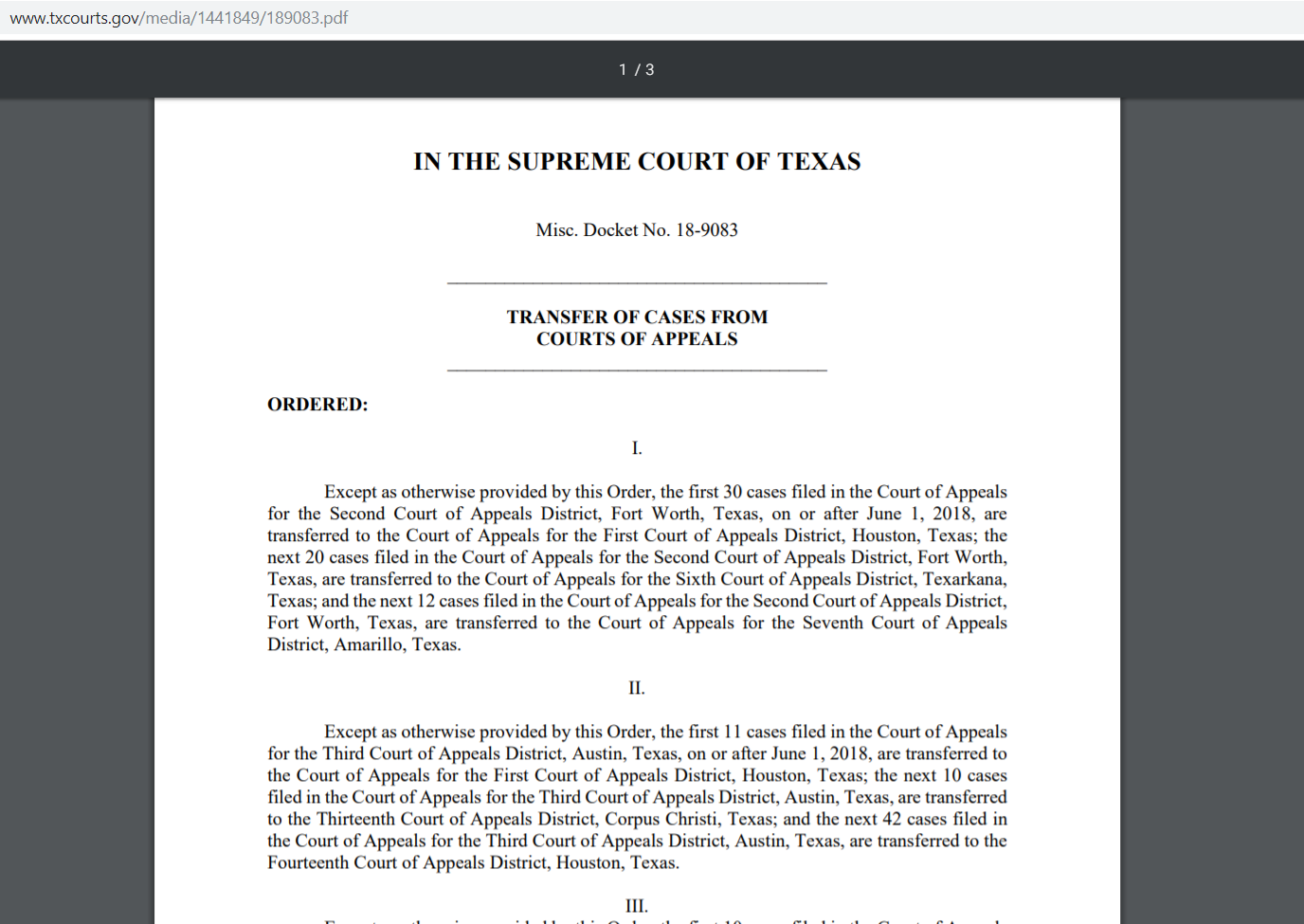
It makes perfect sense for the Texas Supreme Court to even out the dockets among the 14 courts of appeals with transfers orders that send batches of cases from overworked appellate courts to those with spare capacity due to lower demand. To the extent there are inter-jurisdictional differences in the caselaw of different appellate courts and their respective districts, the conflict is addressed by the rule that the receiving COA is to apply the binding precedents of the sending COA. But that does not address all contingencies.

Docket Equalization: Example of SCOTX Order Transferring Appellate Cases
Example of SCOTX Order Transferring Appeals Cases 
Occasionally, a court of appeals faces the issue of whether a nonviable attempted appeal from an interlocutory or otherwise non-appealable order should be deemed a petition for mandamus relief instead.

In a recent family law dispute transferred from the Third Court of Appeals in Austin, the Fourteenth Court of Appeals in Houston concluded that doing so was not an option because the attempted appeals had not originated from its own appellate district (which is coextensive with the First Appellate District) and that it had no mandamus jurisdiction over the judge in Travis County who had signed the challenged orders. That court is outside the appellate district of the two Houston-based courts of appeals. Mandamus jurisdiction apparently did not piggyback onto and travel with the Supreme Court’s docket equalization transfer order that sent the underlying cases to Houston.


Order filed September 27, 2018, Withdrawn; Appeals Dismissed; and Memorandum Opinion filed October 9, 2018.

In The
Fourteenth Court of Appeals
NO. 14-18-00675-CV NO. 14-18-00680-CV

IN THE INTEREST OF M. E. H.

On Appeal from the 345th District Court
Travis County, Texas
Trial Court Cause No. D-1-AG-15-002375

MEMORANDUM OPINION

We withdraw our order dated September 27, 2018.

Appellant C.H. is involved in litigation in Travis County regarding conservatorship of her son, M.E.H. She appealed to the Third Court of Appeals from a final order signed February 2, 2018, called “Order in Suit to Modify Parent-Child Relationship.” The Supreme Court of Texas transferred that appeal to this court on April 11, 2018. See Tex. Gov’t Code Ann. § 73.001. That appeal is pending as number 14-18-00281-CV (“the First Appeal”).

The trial court signed several more orders during the pendency of the First Appeal. Appellant filed pro se notices of appeal from four of those orders, and each appeal was transferred from the Third Court of Appeals to this court as follows:


14-18-00675-CV
May 10, 2018 Order on Motion for Enforcement and Further Orders (regarding C.H.’s Third Amended Motion for Enforcement and Further Orders)
14-18-00680-CV
May 10, 2018 Order on Motion to Revoke Suspension of Commitment (regarding S.K.’s Motion to Revoke Suspension of Commitment)
14-18-00681-CV
May 10, 2018 Order on Motion to Modify Judgment (regarding C.H.’s Motion to Modify Judgment)
14-18-00682-CV
July 9, 2018 Amended Order (regarding June 12, 2018 Order on Respondent’s Plea of Abatement)


None of those four orders is a final judgment or otherwise separately appealable.

For that reason, we notified the parties on August 28, 2018, that we would dismiss those four appeals for lack of jurisdiction unless any party demonstrated meritorious grounds for retaining the appeals.

In response, appellant, through a newly-retained lawyer, filed a motion in the First Appeal characterizing the orders at issue in appeals 14-18-00675-CV and 14-18-00680-CV (“the Contempt Appeals”) as orders refusing to hold the father (appellee S.K.) in contempt and holding appellant in contempt, respectively. Contempt orders are not appealable but are reviewable by mandamus. In re Long, 984 S.W.2d 623, 625 (Tex. 1999) (per curiam); Norman v. Norman, 692 S.W.2d 655, 655 (Tex. 1985) (per curiam). The motion asks us to (1) treat appellant’s pro se notices of appeal in the Contempt Appeals as attempts to invoke our mandamus jurisdiction, and (2) consolidate the Contempt Appeals and the First Appeal.1

Section 22.221 of the Texas Government Code establishes our mandamus jurisdiction. A court of appeals may issue a writ of mandamus against, as relevant here, “a judge of a district, statutory county, statutory probate county, or county court in the court of appeals district[.]” Tex. Gov’t Code Ann. § 22.221(b)(1). We lack jurisdiction to issue a writ of mandamus against the trial judge in this case because she is the judge of the 345th District Court of Travis County, which lies outside our district. Id. § 22.201(d) (stating Travis County lies within Third Court of Appeals District). If appellant were to seek mandamus relief from this court, we would not have jurisdiction to grant that relief.

In conclusion, we lack jurisdiction over these appeals, and we would lack jurisdiction to grant mandamus relief if we were to construe the notices of appeal as attempts to invoke our mandamus jurisdiction. Accordingly, the appeals are dismissed.

PER CURIAM

Panel consists of Justices Christopher, Jamison, and Brown.

1 The motion also abandons appeals 14-18-00681-CV and 14-18-00681-CV (“the Abandoned Appeals”). We construed that abandonment as a motion for voluntary dismissal under Texas Rule of Appellate Procedure 42.1(a)(1) and dismissed the Abandoned Appeals on September 18, 2018. In re M.E.H., Nos. 14-18-00681-CV, 14-18-00682-CV, 2018 WL 4427486 (Tex. App.—Houston [14th Dist.] Sept. 18, 2018, no pet. h.) (mem. op.) (per curiam).

Keywords: docket equalization, case-transfer among intermediate Texas courts of appeals, split of authority among appellate courts, precedents

Tuesday, April 10, 2018

[Comment] Houston Court of Appeals guts $10K jurisdictional limit of JP Courts on Appeal, citing itself as authority - Chapman v. Pham (Tex.App.- Houston 2018)

The jurisdictional limit of justice courts has been raised several times by the Texas Legislature and currently stands at $10,000, interest excluded - unless an appellate court says otherwise, of course, as the First Court of Appeals just did last week. Aletha Chapman v. Thinh Quoc Pham, No. 01-13-00066-CV (Tex.App.- Houston [1st Dist.] Apr. 3, 2018) (attorneys' fees awarded by county court on appeal from JP court do not count towards the jurisdictional cap).


You might think that attorney's fees increase as attorney work is performed and charged at reasonable rates. A panel on one of the two Houston Courts of Appeals, however, just opined that attorneys fees increase as a function of passage of time, citing itself as authority. At least for purposes of affirming a judgment in excess of $10,000 granted by a county court in a case appealed from JP court, which included an award of $5,000 in attorney fees that brought the total amount in controversy over the $10,000 limit. In such appeals, the jurisdiction of the county court is limited to the jurisdiction of the JP court. Unless, of course, the court of appeals creates an exception. 

-- What is the point of a jurisdictional limit set by the Legislature if an appellate court then does not enforce it and allows it to be exceeded by heavy litigation activity and concomitant fees?  


ALETHA CHAPMAN, Appellant,

v.
THINH QUOC PHAM, Appellee.

No. 01-13-00066-CV.
Court of Appeals of Texas, First District, Houston.
Opinion issued April 3, 2018.

Thinh Quoc Pham, for Appellee, Pro Se.
Michele B. Chimene, for Aletha Chapman, Appellant.

On Appeal from County Civil Court at Law No. 3, Harris County, Texas, Trial Court Case No. 1006033.
Panel consists of Justices Higley, Bland, and Brown.

MEMORANDUM OPINION

LAURA CARTER HIGLEY, Justice.

Thinh Quoc Pham, appellee, sued Aletha Chapman, appellant, in a Harris County small claims court, claiming property damage caused by Chapman. Pham appealed the small claims court's take-nothing judgment to a Harris County civil court at law. Chapman now appeals the judgment rendered against her in that court. In two issues, Chapman argues that the county court at law lacked jurisdiction because Pham did not timely appeal the justice court's judgment and that the county court at law's judgment exceeded the court's jurisdictional limits.

We affirm.

Background

Pham filed suit against Chapman in a Harris County small claims court in July 2011. Pham alleged damage to his condominium unit following a leak in Chapman's upstairs condominium unit. The small claims court rendered a take-nothing judgment against Pham on November 29, 2011.

On December 8, 2011, the small claims court transferred to the county court $197, identified as "plaintiff's cash appeal bond." Pham retained an attorney to represent him in the county court. Chapman briefly did the same. After a trial, the county court rendered a judgment in favor of Pham. The court awarded $6,900 in actual damages, $5,000 in attorneys' fees, and court costs.

Standard of Review

Both of Chapman's issues challenge the county court at law's subject-matter jurisdiction. We review issues challenging a trial court's jurisdiction de novo. Tex. Dept. of Parks & Wildlife v. Miranda, 133 S.W.3d 217, 226 (Tex. 2004).

Appeal of Justice Court Judgment

In her first issue, Chapman argues that the county court lacked jurisdiction over Pham's appeal of the small claims court's judgment because Pham did not timely perfect appeal to the county court. The rule applicable at the time Pham appealed to the county court required a bond to be paid within ten days of the judgment being signed. TEX. R. CIV. P. 571, 53 Tex. B.J. 589, 605 (Tex. 1990, repealed 2013). The small claims court signed its judgment on November 29, 2011. Chapman argues that Pham's bond was not filed until December 14, 2011, outside of the ten-day window. We disagree.

The record, as ordered to be supplemented by this Court, shows that the small claims court submitted to the county clerk—the clerk for the county court—Pham's appeal bond on December 8, 2011. This indicates that Pham paid his appeal bond on or before the 8th, within the ten-day window of the signing of the small claims court's judgment.

The document that established the cash bond was transferred is file stamped December 14, 2011. This is the date that the document was formally filed in the county clerk's records. It is not the date that Pham submitted the bond to the small claims court.
We overrule Chapman's first issue.

Jurisdictional Limits on Damages

In her second issue, Chapman argues that the county court's judgment award exceeds the jurisdictional limit placed on it. Pham retained an attorney to represent him in the county court. The judgment awards Pham $6,900 in actual damages, $5,000 in attorneys' fees, and court costs. Chapman argues that the county court was jurisdictionally limited to awards of $10,000 or less and that, accordingly, the award must be reduced to $10,000 in total.

The small claims court lacks jurisdiction over civil matters in which the amount in controversy is more than $10,000, "exclusive of interest." TEX. GOV'T CODE ANN. § 27.031(a)(1) (West Supp. 2017). "The appellate jurisdiction of a statutory county court is confined to the jurisdictional limits of the justice court, and the county court has no jurisdiction over an appeal unless the justice court had jurisdiction." Rice v. Pinney, 51 S.W.3d 705, 708 (Tex. App.-Dallas 2001, no pet.). As a result, "a county court may not issue an award against a principal on appeal that exceeds the jurisdiction of the justice court unless the additional damages were sustained as a result of the passage of time." Kendziorski v. Saunders, 191 S.W.3d 395, 406 (Tex. App.-Austin 2006, no pet.). An example of damages sustained as a result of the passage of time is attorneys' fees incurred in prosecuting the case in the county court. Id. at 409; Lost Creek Ventures, LLC v. Pilgrim, No. 01-15-00375-CV, 2016 WL 3569756, at *8 (Tex. App.-Houston [1st Dist.] June 30, 2016, no pet.) (mem. op.). Because the attorneys' fees incurred in the county court do not count towards the jurisdictional cap on the judgment, the county court's judgment does not exceed the cap.

We overrule Chapman's second issue.

Conclusion

We affirm the judgment of the trial court.


TEXAS GOVERNMENT CODE
TITLE 2. JUDICIAL BRANCH SUBTITLE A. COURTS CHAPTER 27. JUSTICE COURTS
SUBCHAPTER B. JURISDICTION AND POWERS
Sec. 27.031. JURISDICTION. (a) In addition to the jurisdiction and powers provided by the constitution and other law, the justice court has original jurisdiction of:
(1) civil matters in which exclusive jurisdiction is not in the district or county court and in which the amount in controversy is not more than $10,000, exclusive of interest;
(2) cases of forcible entry and detainer;
(3) foreclosure of mortgages and enforcement of liens on personal property in cases in which the amount in controversy is otherwise within the justice court's jurisdiction; and
(4) cases arising under Chapter 707, Transportation Code, outside a municipality's territorial limits.
(b) A justice court does not have jurisdiction of:
(1) a suit in behalf of the state to recover a penalty, forfeiture, or escheat;
(2) a suit for divorce;
(3) a suit to recover damages for slander or defamation of character;
(4) a suit for trial of title to land; or
(5) a suit for the enforcement of a lien on land.
(c) A justice court has concurrent jurisdiction with a municipal court in cases that arise in the municipality's extraterritorial jurisdiction and that arise under an ordinance of the municipality applicable to the extraterritorial jurisdiction under Section 216.902, Local Government Code.
(d) A corporation need not be represented by an attorney in justice court.
(e) A justice court has concurrent jurisdiction with a district court and a municipal court of record over expunction proceedings relating to the arrest of a person for an offense punishable by fine only.
Acts 1985, 69th Leg., ch. 480, Sec. 1, eff. Sept. 1, 1985. Amended by Acts 1987, 70th Leg., ch. 745, Sec. 2, eff. June 20, 1987; Acts 1991, 72nd Leg., ch. 776, Sec. 2, eff. Sept. 1, 1991.
Amended by:
Acts 2007, 80th Leg., R.S., Ch. 383 (S.B. 618), Sec. 2, eff. September 1, 2007.
Acts 2007, 80th Leg., R.S., Ch. 612 (H.B. 413), Sec. 12, eff. September 1, 2007.
Acts 2007, 80th Leg., R.S., Ch. 1149 (S.B. 1119), Sec. 2, eff. September 1, 2007.
Acts 2009, 81st Leg., R.S., Ch. 87 (S.B. 1969), Sec. 27.001(18), eff. September 1, 2009.
Acts 2017, 85th Leg., R.S., Ch. 1149 (H.B. 557), Sec. 6, eff. September 1, 2017.
JUSTICE COURT VS. SMALL CLAIMS COURT (NOW DEFUNCT) 

In re United Services Auto. Ass'n, 307 SW 3d 299 (Tex. 2010)

Appellate rights can vary depending on which court a case is filed in, even among trial courts with concurrent jurisdiction, and even when the same judge in the same courtroom presides over two distinct courts. See, e.g., Sultan, 178 S.W.3d at 752 (holding that there was no right of appeal to courts of appeals from cases originating in small claims courts, but recognizing that justice court judgment would be appealable); see also id. at 754-55 (Hecht, J., dissenting) (noting that the same justice of the peace hears small claims cases and justice court cases).[6] 
[6] Section 28.053 of the Government Code, at issue in Sultan, was recently amended to allow appeals to the court of appeals from de novo trials in county court on claims originating in small claims court. See Act of June 19, 2009, 81st Leg., R.S., ch. 1351, section 8, 2009 Tex. Gen. Laws 4274, 4274.