Friday, May 22, 2015

Goodfriend v Travis County Clerk - Documents from Texas Same-Sex Marriage Licence Case


Goodfriend v Dana DeBeauvoir, Travis County Clerk
Same-sex Marriage License Case: Documents 

Screen capture of web page of Dana DeBeauvoir, Travis County Clerk,
with announcement of same-sex marriage license 

A more complete collection of trial court documents is now available from the Texas Supreme Court website and can be accessed through hyperlinks on the docket sheet for case number 15-0139. 

Below is a selection a screenshots of key documents (or portions thereof) with stickie notes. The additional documents were filed in conjunction with the couple's response to the Attorney General's petition for mandamus relief attacking the temporary restraining order signed by Judge Wahlberg that led to the issuance of the first same-sex marriage license in Texas by a county clerk. In their brief, the couple's attorneys argue that the supreme court mandamus proceeding initiated by Attorney General Ken Paxton is moot because the controversy became moot when the marriage license was granted and the marriage celebrated, and the case against the Travis County Clerk was dropped. They also argue that there is no proper basis for mandamus relief because there is an adequate remedy to declare the marriage void under the Texas Family Code. Mandamus relief is generally not available when there is an adequate remedy.
 
The additional documents also include an affidavit by Attorney Charles Herring Jr with his account of the events leading to issuance of first same-sex marriage license in Texas by Travis County Clerk, Dana DeBeauvoir. The gist of  it is that the TRO was granted after a contested hearing, rather than ex parte.

AFFIDAVIT OF ATTORNEY FOR SARAH GOODFRIEND AND SUZANNE BRYANT
IN THE TRIAL COURT

 Attorney Charles Herring Jr account of TRO hearing leading to issuance of first same-sex marriage license in Texas

 Affidavit of Attorney Charles Herring Jr 
on events leading up to hearing, grant of TRO by Judge Wahlberg, 
and issuance of first same-sex marriage license in Texas   


Source: Supplemental Mandamus Record filed on 5/13/2015 in the Texas Supreme Court in the case brought by the Texas Attorney General seeking to invalidate the marriage license granted to Sarah Goodfriend and Suzanne Bryant. IN RE STATE OF TEXAS, No. 15-0139 (hyperlink to online docket). 


WAHLBERG ORDER FOR ISSUANCE OF MARRIAGE LICENSE 
TO SAME-SEX COUPLE


ORDER WAIVING 72-WAITING PERIOD FOR MARRIAGE CEREMONY
(sometimes called cooling-off period, though that would be a misnomer in this case, given the same-sex couple's long-standing desire to get married, and not being able to do so due to the legal impediment) 


After obtaining their marriage license armed with a court order, Sarah Goodfriend and Suzanne Bryant promptly dropped their case against the Travis County Clerk. 

NOTICE OF NONSUIT AFTER ISSUANCE OF LICENSE


Nonsuit in Travis County Same-Sex Marriage Licenses Case 
PETITION FOR TRO FILED BY GOODFRIEND AND BRYANT
(signature block and verification page omitted) 


Here is the link to the ---> Goodfriend v DeBeauvoir petition and application for temporary restraining order on the Travis County Clerk's website.  


Tuesday, April 14, 2015

Can one Texas court of appeals make law for another? ... Apparently so, under some circumstances


TEXAS SUPREME COURT TRANSFERS CASES AMONG THE INTERMEDIATE COURTS TO EVEN OUT THE DOCKETS, BUT THIS CAN CREATE A CONUNDRUM WHEN THE INTERMEDIATE COURTS ARE SPLIT ON AN UNSETTLED LEGAL ISSUE 

Transfer of cases among the courts of appeals combined with the rule that they be decided based on the precedents of the transferring court (officially called the "transferor court") represents yet another wrinkle in what even some justices acknowledge is a byzantine court system in Texas. See, e.g., Texas Supreme Court Justice Willett's Dissent in In re Reece, 341 SW 3d 360 (Tex. 2011).

The recent decisions of the Corpus Christi and Eastland Courts of Appeals in three credit card debt cases -- all transferred from the Second Court of Appeals in Fort Worth -- provide an apt illustration that docket equalization can be more than a merely administrative matter. Case transfers can have significant ramifications for the evolution of the common law as articulated through the decisions of the intermediate courts when the there is no controlling authority from the state's highest court.
  • Rose Core v. Citibank (South Dakota, N.A.) No. 11-13-00040-CV (Tex.App.- Eastland [11th Dist.] February 27, 2015, motion for rehearing filed)(Op by Justice John M. Bailey)(case transferred from Second Court of Appeals in Fort Worth). Trial court: 362nd District Court in Denton County (Judge Bruce McFarling).  
  • Marc R. Core v. Citibank, N.A., No. 13-12-00648-CV (Tex.App.- Corpus Christi, Edinburg [13th Dist.], April 9, 2015, no pet h.) (Opinion by Justice Rodriguez)(also on transfer from 2nd COA in Fort Worth). Trial court: 211th District Court in Denton County (Judge Lawrence Dee Shipman).  
  • Scott Walker v. Citibank, N.A. No. 11-13-00042-CV (Tex.App.- Eastland [11th Dist.], Feb. 27, 2015, pet. to be filed under Cause No. 15-0287   (Op. by retired Justice Terry McCall, sitting by assignment) (case transferred from the 2nd Court of Appeals) Trial court: 342nd District Court in Tarrant County (Judge J. Wade Birdwell). 
All three were were transferred from the Second Court of Appeals in Fort Worth, but not to the same sister court. Marc R. Core v Citibank went to the Corpus Christi Court of Appeals, while the other two (Rose Core v Citibank and Scott Walker v Citibank) went to Eastland. One of the case had been appealed from Tarrant County (Fort Worth), while the other two originated in Denton County.

Both receiving courts were obligated to apply the caselaw of the Fort Worth Court of Appeals, rather than their own, but the state of the case law on the legal issue raised on those cases -- the viability of the account stated theory in the context of a defaulted credit card account, and the associated proof requirements -- was not entirely clear based on prior decisions of that court, not to mention settled.

PRIOR FORT WORTH CASE ON "ACCOUNT STATED" CLAIM BY CITIBANK 

There were two prior cases from the Fort Worth-based court, but neither of them "published" (i.e. published in the South Western Reporter), and in a prior case involving Citibank, the Fort Worth-based court of appeals had ruled that Citibank had not proven its case under the applicable evidentiary standard, and had accordingly reversed the judgment granted in the bank's favor. The court remanded for a new trial. See Morrison v. Citibank (South Dakota), N.A., 2008 W.L. 553284, 2008 Tex. App. Lexis 1692 (Tex. App. - Fort Worth 2008, no pet.) (mem. op.) (per curiam).


In Morrison, the Fort Worth-based court stated:
Assuming without deciding that account stated may be employed to collect credit card debt under Texas law, we nevertheless conclude that the evidence is too weak to support the trial court's judgment.
The court resolved the consumer's appeal of the judgment in favor of Citibank on sufficiency-of-evidence grounds and expressly declined to say whether it accepted account stated as a viable theory of recovery for credit card debt. The review was for factual sufficiency because the underlying judgment was entered after a bench trial.

In all the appellate cases involving the account-stated theory in the credit card debt context decided by other Texas courts of appeals, the creditor had won, and in most of these cases the creditor was Citibank. The bank was represented by the very same attorneys that also created the new precedent in Dallas upon which these cases rely as authority: Dulong v. Citibank (South Dakota), N.A., 261 S.W.3d 890 (Tex. App.–Dallas 2008, no pet.). Thus, the bank was in a position to cite its own prior ligation victories as legal authority.  See --> The Citibank Doctrine: Account Stated for Credit Card Debt Collection.

In Dulong, the Dallas Court of Appeals modified then-existing caselaw governing account-stated by approving it as a viable theory of collection of a financial debt incurred with a bank (as opposed to a debt incurred through purchase of goods or rendition and acceptance of services).

In subsequent cases, it stuck to its novel interpretation of the suit on account theory, and in one of those subsequent cases it overtly expressed its disagreement with the Fort Worth court's holding in Morrison, which was most directly on point in a case involving the same plaintiff. See Compton v. Citibank (S.D.), N.A., 364 S.W.3d 415, 419–20 (Tex. App.—Dallas 2012, no pet.) (citing Dulong, 261 S.W.3d at 894). On multiple occasion since, the Dallas court has cited its novel precedent for the proposition that Citibank was exempted from having to prove the underlying contract if it sought judgment on account stated, which only required proof of an agreement on the amount, rather than on credit terms, and held that such an agreement on the amount could be implied, i.e. it did not have to be articulated.


Both courts that heard the three Citibank account-stated cases transferred from Fort Worth ended up distinguishing the Morrison case decided by that court, and ended up following the Dallas Court of Appeals. They did so notwithstanding the express split between the Second and the Fifth, and the Dallas court's express rejection of the holding of the sister court in Fort Worth.

COURT OF APPEALS' SPAT OVER CITIBANK'S THEORY: DALLAS VS. FORT WORTH 

The Dallas court was adamant about not having to follow the prior decisions of a sister court, and was on solid ground in taking that position in the absence of binding Texas Supreme Court precedent. The transferree courts, by contrast, were required to follow the precedents of the transferor court.

Significantly, in the prior case in which Citibank had pushed its revamped account-stated theory in the Fort Worth Court of Appeals - Morrison v Citibank -- it had failed, and that was the very case that the Dallas Court of Appeals took issue with in Compton.


Did the transferree courts acknowledge taking sides with Dallas in the Metroplex split? 

In Marc Core v Citibank, the Thirteenth Court of Appeals acknowledged the dicey issue of precedent in a footnote, pointing out that Morrison was just a memorandum opinion, but also distinguished the cases on the facts. In the Morrison case, ten accounts were involved in a single lawsuit while in both Core v Citibank cases there was only one each. ("Factually, this appeal only involves a single credit card account.", at p. 16). But that seems a lame distinction, for the law would be identical regardless of whether there is only one account or several.

The distinction of Morrison on the basis that it involved reversal of a judgment rendered after a bench trial (at p. 16) sounds equally hollow, because the evidentiary standard for entitlement to summary judgment (in Core v Citibank) was higher, not lower. In Core, Citibank had to prove all substantive elements of its cause of action conclusively, while in Morrison - which involved resolution of all issues in a trial to the bench -- it only had to prove each element under the preponderance-of-the-evidence standard. Additionally, factual discrepancies and conflicts in the evidence can be resolved by the fact finder at trial, while they preclude summary disposition if they concern material issues of fact in the summary judgment context.

As for the issue whether Morrison was binding on it, the Corpus Christi court said the following about the Fort Worth court's opinion:
The fact that Morrison v. Citibank (South Dakota), N.A., is a memorandum opinion from the Second Court of Appeals is significant because this case was transferred to us from the Second Court of Appeals in Fort Worth pursuant to an order of the Texas Supreme Court under the authority of section 73.001 of the Texas Government Code. See No. 2-07-00130-CV, 2008 WL 553284, at *1–3 (Tex. App.—Fort Worth Feb. 28, 2008, no pet.) (mem. op.) (per curiam); see also TEX. GOV’T CODE ANN. § 73.001. In accordance with rule 41.3 of the Texas Rules of Appellate Procedure, we are required to follow the precedent of the Fort Worth Court of Appeals “unless it appears that the transferor court itself would not be bound by that precedent.” TEX. R. APP. P. 41.3.
The jurisprudentially most significant issue in all of these cases -- transferred or otherwise -- is the legal issue of whether account stated is a proper theory for collection of a financial debt owned to a bank, rather than to a merchant and seller of goods or services.

Although the Corpus-based court cites Morrison v Citibank for the elements of account stated (along with recent cases from other courts including Dulong), the Fort Worth Court of Appeals had reserved judgment on that issue.

A DOCTRINAL QUESTION, NOT MERELY ONE OF EVIDENTIARY SUFFICIENCY 

The matter of whether "account stated" can serve as an alternative legal theory to breach of contract in a suit to recover a credit card debt, which is necessary based on a contract because statutory law requires it, is a quintessential matter of substantive law, rather than merely one of fact and sufficiency of the evidence, although the nature of the theory obviously also dictates the type or proof needed to satisfy its essential elements.

In Morrison, the Fort Worth Court of Appeals stated:
Assuming without deciding that account stated may be employed to collect credit card debt under Texas law, we nevertheless conclude that the evidence is too weak to support the trial court's judgment.
The Fort Worth Court of Appeals thus resolved Morrison's appeal of the judgment in favor of Citibank on factual sufficiency grounds and expressly declined to determine whether it accepted account stated as a viable theory of recovery for credit card debt.

It also pointed out, citing Neil v. Agris, 693 S.W.2d 604 (Tex.App.-Houston [14th Dist.] 1985, no writ), which the Dallas Count had also cited in Dulong, that Citibank had not established the reasonableness of the price in the absence of an agreement:
[Affiant] Guenther did not testify that the prices charged were usual, customary, and reasonable, a potential alternative to proving the second element. See Neil, 693 S.W.2d at 605.
In other words, the Fort Worth Court of Appeals adhered to the precedents pre-dating the Dallas Court's Dulong decision. It relied on the case law that treats account stated and open account as claims arising from transactions involving the sale of goods or services by merchants. Under those theories, the plaintiff has the burden to prove that it provided goods or services, and the price/charges were either agreed to by the parties, or were customary and reasonable as established by other evidence, absent an agreement.

Those requirements still apply in a suit on sworn account when the petition does not strictly conform with the requirements of Rule 185, or when the Defendant files a sworn denial and thus neutralizes the evidentiary benefits of Rule 185. --> Credit card debt suit cannot be brought as a sworn-account.

CAN ONE COURT OF APPEALS SET BINDING PRECEDENT FOR ANOTHER?

It is probably fair to say that the courts in Corpus Christi and Eastland were not bound by Morrison, and that they did establish the precedent that the Fort Worth court was not prepared to set in Morrison, even though the Fort Worth court could have done so, -- one way or the other.

Does that mean that the Fort Worth court is bound by the holding of the Thirteenth and Eleventh Courts of Appeals regarding account stated as a proper theory for credit card debt collection in the transferred case? Apparently so.

But will the Fort Worth court accept the legitimacy of another court acting in its stead when the court had chosen not to decide whether a credit card debt collection case is properly brought as an "account stated" claim, and had save that issue for another day? Particularly when considering that the Dulong case, on which the subsequent account-stated cases rely as authority, is doctrinally flawed and creates conflict with long-standing caselaw on open account and account stated outside the context of credit card debt collection.

It remains to be seen.

CASES INVOLVING ACCOUNT STATED IN THE CREDIT CARD DEBT CONTEXT

CORPUS CHRISTI COURT OF APPEALS (ON TRANSFER FROM FORT WORTH)

[Marc] Core v. Citibank, N.A., No. 13-12-00648-CV (Tex.App.- Corpus Christi, Edinburg [13th Dist.], April 9, 2015, no pet h.) (Opinion by Justice Rodriguez)

EASTLAND COURT OF APPEALS (ON TRANSFER FROM FORT WORTH) 

[Rose] Core v. Citibank (S.D.), N.A., now known as Citibank, N.A.,  No. 11-13-00040-CV (Tex.App.- Eastland [11th Dist.] February 27, 2015, motion for rehearing filed )(Op by Justice John M. Bailey)(case transferred from Second Court of Appeals in Fort Worth)

Walker v. Citibank, N.A., No. 11-13-00042-CV, 2015 WL 1004395, at *3 (Tex.App.- Eastland [11th Dist.], Feb. 27, 2015) (Op. by retired Justice Terry McCall, sitting by assignment) (case transferred from the 2nd Court of Appeals) (concluding that “an account[-]stated cause of action is appropriate for a suit to collect credit card debt” and setting out the elements of an account-stated claim)

FORT WORTH COURT OF APPEALS

Morrison v. Citibank (S.D.) N.A., No. 02-07-00130-CV, 2008 WL 553284, at *1 (Tex. App.—Fort Worth Feb. 28, 2008, no pet.) (mem. op.) (per curiam) (judgment in favor of Citibank on account stated theory reversed in suit involving ten credit card accounts).

DALLAS COURT OF APPEALS

DuLong v. Citibank (S.D.), N.A., 261 S.W.3d 890, 893 (Tex. App.—Dallas 2008, no pet.)

Compton v. Citibank (S.D.), N.A., 364 S.W.3d 415, 419–20 (Tex. App.—Dallas 2012, no pet.) (citing DuLong, 261 S.W.3d at 894)(follow-up case stating disagreement with Fort Worth court's opinion in Morrison).

Hays v. Citibank (S.D.), N.A., No. 05-11-00187-CV, 2012 WL 929673 (Tex.App.-Dallas Mar. 16, 2012, no pet. h.) (mem. op.)

Owusu v. Citibank (S.D.), N.A., No. 05-10-00175-CV, 2011 WL 2465475 (Tex.App.-Dallas June 22, 2011, no pet.) (mem. op.)

Moir v. Citibank (S.D.), N.A., No. 05-09-00641-CV, 2010 WL 2574212 (Tex. App.-Dallas June 29, 2010, no pet.) (mem. op.)

AUSTIN COURT OF APPEALS

Singh v. Citibank (S.D.), N.A., 03-10-00408-CV, 2011 WL 1103788 (Tex.App.-Austin Mar. 24, 2011, no pet.) (mem. op.)

Damron v. Citibank (S.D.), N.A., No. 03-09-00438-CV, 2010 WL 3377777 (Tex.App.-Austin Aug. 25, 2010, pet. denied) (mem. op.)

SAN ANTONIO COURT OF APPEALS 

Rodriguez v. Citibank, N.A., No. 04-12-00777-CV, 2013 WL 4682194 (Tex. App.—San Antonio Aug. 30, 2013, no pet.) (mem. op.)

WACO COURT OF APPEALS 

McGrew v. Citibank (S.D.), N.A., No. 10-07-00343-CV, 2009 WL 1693473 (Tex.App.-Waco 2009, no pet.) (mem. op.)

HOUSTON COURT OF APPEALS

Busch v. Hudson & Keyse, LLC, 312 S.W.3d 294, 299 (Tex. App.—Houston [14th
Dist.] 2010, no pet.)

EL PASO COURT OF APPEALS

Eaves v. Unifund CCR Partners, 301 S.W.3d 402 (Tex. App.—El Paso 2009, no pet.)


Sunday, March 15, 2015

Appellate Caseloads in the Texas Courts of Appeals - Comparative Data from the 2014 Statistical Report


ANNUAL STATS ON ACTIVITY BY THE INTERMEDIATE COURTS OF APPEALS 
FISCAL YEAR 2014 (2013-2014) 

Due to space limitations, not all of the data collected and made available by the Office of Court Administration can be included in its annual report. Additional data can be accessed and downloaded on the agency's webpage, however. The table below was included in the most recent report and presents a comparative overview of cases filed and processed by each court of appeals.

The remainder of the blog provides info on where to find statistical information on opinion writing by individual justices on each court that reflects their respective productivity, and the amount of agreement and disagreement with their peers on the same court, as reflected in the incidence of concurring and dissenting opinions.

SOURCE: Annual Statistical Report for the Texas Judiciary for Fiscal Year 2014 

DRILL-DOWN AND GREATER DETAIL ON NUMBER AND TYPES OF OPINIONS AUTHORED BY INDIVIDUAL JUSTICES 

Opinion production stats broken down by court and individual members of each courts are also available from the Office of Court Administration (OCA), though not published in the Annual Statistical Report.

The more detailed information includes the following: 

  • Activity Detail
  • Opinion Summary
  • Appeals by County

The last three data collections  - Activity Detail, Opinion Summary, and Appeals by County -- are in the form of downloadable spreadsheets.

Tables for each appellate court showing opinion authorship by justice (which are derived from the spreadsheet data files referenced above) can be found on the CoA-specific pages of this blawg (click hyperlink for each CoA in the masthead above).

Questions addressed by this blog post: How many cases do the Texas Courts of Appeals decide per year. Where can I find statistics on cases heard by the courts of appeals? How many cases are appealed in Texas? Where can I find information on the number of appellate cases decided by the intermediate courts of appeals in Texas? Statistics on the appellate court system in Texas.


Friday, March 13, 2015

How common are Jury Trials in Texas?


HOW COMMON ARE JURY TRIALS IN TEXAS?

- It depends how one looks at it.    

In large metropolitan jurisdictions with numerous county and district courts, citizens are summoned for jury duty in large numbers. Though only a certain percentage complies, jurors (or potential jurors, if not yet selected) are a daily presence at the courthouse. Because the county and district clerk cannot accurately predict how may will be needed, and how many will answer the call, many citizens called for jury duty may not be chosen to serve, and may not even be escorted to a courtroom for voir dire, which the legal term for the process which involves instructions and examination of potential jurors – also called members of the venire -- for suitability to actually serve on a jury. So, especially in populous counties, juries and jury service, are part and parcel of the local judicial system.

Statistically, however, jury trials are rare, compared to other dispositions. That is true both of civil and criminal cases. The proportion of jury trials in criminal cases is much higher than in civil cases, but only as a percentage of the cases that go to trial, as opposed to all cases. The latter percentage is small, because most cases are disposed of by plea-bargaining.

According to the most recent Annual Statistical Report for the Texas Judiciary, overall, only 3.1 percent of all criminal cases (excluding motions to revoke probation) went to trial in Fiscal Year 2014. The highest trial rate occurred in murder cases (27.8 percent), followed by capital murder cases (25.6 percent). Of the 6,493 cases that went to trial, 39.9 percent were tried before a jury. Defendants were convicted in 81.1 percent of cases that went to jury trial, compared to 93.8 percent that were convicted in cases that were decided by a judge.

The charts, from the Annual Statistical Report reproduced below, which report case disposition for different types of trial courts, illustrate the rarity of jury trials in civil cases:

DISPOSITION OF CIVIL CASES IN DISTRICT AND COUNTY COURTS IN TEXAS 

Disposition of Civil Cases in District Courts 
Disposition of Civil Cases in Statutory County Courts 

Disposition of Civil Cases in Constitutional  County Courts


CONSTITUTIONAL RIGHT TO JURY TRIAL – TEXAS CONSTITUTION


Sec. 15.  RIGHT OF TRIAL BY JURY.  The right of trial by jury shall remain inviolate.  The Legislature shall pass such laws as may be needed to regulate the same, and to maintain its purity and efficiency.  Provided, that the Legislature may provide for the temporary commitment, for observation and/or treatment, of mentally ill persons not charged with a criminal offense, for a period of time not to exceed ninety (90) days, by order of the County Court without the necessity of a trial by jury. 

(Amended Aug. 24, 1935.)
  
JURY ASSEMBLY BUILDING - HARRIS COUNTY JURY PLAZA 

Photo of Harris County Jury Plaza with Jury Assembly Building
Harris County Jury Plaza - Entrance to Underground Facility 
Harris County has a dedicated jury assembly facility, most of it underground, which is located in the square that is framed by its multiple courthouses: the Harris County Civil Courthouse, the Criminal Justice Center, the Family Law Center, and the Juvenile Justice Center.

The 1910 Courthouse that is now the seat of the First and Fourteenth Court of Appeals, is one block to the West.
1910 Harris County Courthouse
with Downtown Houston Office Towers  
Questions addressed by this blawg post: How many cases are tried by jury and without a jury. How common a jury trials in Texas courts? Does the Texas Constitution guarantee the right to trial by jury?  

Descriptors: Statistics on use of jury trials in Texas. Incidence of jury trails versus bench trial and other dispositions. Texas trial courts. Texas jury system. Jury trial system in Texas. Disposition by trial and other types of dispositions of civil and criminal court cases. 

Additional features or content: Photo of Harris County Jury Assembly Building; image of old Harris County Courthouse from the direction of the Jury Plaza / Civil Courthouse. 


Tuesday, March 10, 2015

Texas Attorney General Ken Paxton v. Judges David Wahlberg, Guy Herman et al - Same-Sex Marriage and Divorce in the Texas Supreme Court


IS THE SAME-SEX MARRIAGE LICENSE CASE NOW MOOT?

The most recent cases involving same-sex marriage and divorce don't have a catchy case style because they were filed as mandamus petitions on behalf of the State and are therefore both styled In Re State of Texas. The case numbers are 15-0135 and 15-0139.

But they might as well be styled Texas Attorney General Ken Paxton v. District Judge  David Wahlberg and Ken Paxton v. Probate Court Judge Guy Herman.

Wahlberg and Herman are the Honorables that drew the ire of the Attorney General because they signed orders which include a determination that the Texas state-law prohibition of same-sex marriage is unconstitutional under the due process and equal protection clauses in the Civil War Amendments to the federal constitution.

Judge Herman did so in an inheritance dispute between the family of a deceased woman and another woman who alleges that she was the deceased woman's common-law spouse. Estate of Stella Marie Powell, No. C-1-PB-14-001695 (Travis Cnty. Probate Ct. No. 1). Herman's ruling is in the form of an order denying the family member's motion to dismiss the competing claim by the woman claiming to be the surviving spouse and, as such, entitled to a share of the estate under the intestacy laws.

In the second case, Judge Wahlberg issued a TRO (temporary restraining order) enjoining the County Clerk of Travis County (Austin) from denying a marriage license to a same-sex couple on the basis of the same-sex marriage prohibition in Texas law. See excerpts from both orders at the bottom of  this post. He also waived the statutory 72-hour waiting period for a marriage license for medical reasons.

PAXTON NOW HAS A NON-SUIT PROBLEM 

In Case No. 15-0139 -- the case involving the same-sex marriage license -- Paxton has now filed an amended petition for writ of mandamus after having discovered that the two women who had obtained a marriage license armed with the temporary restraining order (TRO) signed by Judge Wahlberg -- Sarah Goodfriend and Suzanne Bryant -- had non-suited the case in Travis County district court after getting married.

So Paxton now has a moot case on his hands because when a case is nonsuited, it is over and closed.  
Since the all-Republican Texas Supreme Court is the court of last resort, it is always possible that an exception will be fashioned to mark the occasion of the first marriage license being issued to a gay couple in Texas, i.e. that the mootness doctrine will be modified, and that the marriage will yet be nixed by the higher court even though the case in the trial court is no longer alive and pending.

Under existing law, however, the rule governing nonsuits is pretty clear and pretty drastic. The plaintiff's right to non-suit is virtually absolute, and the trial court judge has no discretion to deny it. Moreover, the nonsuit is effective upon filing, not when the judge subsequently signs an order of dismissal as a merely "ministerial" act, i.e. a formality that leaves no discretion to the judge to decide whether it should be granted or denied.

The Supreme Court reiterated that principle as recently as two months ago in a footnote in Texas Department of Aging and Disability Services v Cannon, No. 12-0830 (Tex. Jan. 9. 2015), albeit in a slightly different context.
[13] By contrast, a nonsuit is effective without a court order immediately when notice is filed or announced in open court. FKM P'ship, Ltd. v. Bd. of Regents of Univ. of Hous. Sys., 255 S.W.3d 619, 632-33 (Tex. 2008).  

There is an exception to automatic case-termination upon nonsuit, and that is when the opposing party has filed a counterclaim (or a claim for sanctions) that remains pending. But the opposing party in the same-sex marriage case was Dana DeBeauvoir, the Travis County Clerk, and she was not even unhappy to be ordered to issue the marriage license, as quoted by the TEXAS LAWYER (“It’s a really happy day. I think a lot of us have arrived at the conclusion that this is a civil rights issue, so I was most definitely following a court order, but I was doing so happily,”). She might even do it again, but only by court order. See below.

SAME-SEX MARRIAGE LICENSES PER ORDER
- BUT THE ORDER MUST COME FROM A COURT
No confusion there regarding possible future issuances, contrary suggestion by the Attorney General notwithstanding, at least not with respect to county clerks, including Dana DeBeauvoir. ("Also, other same-sex couples, courts, and county clerks may mistakenly believe that Texas’s marriage laws have been invalidated, clearing the way for the erroneous issuance of other invalid same-sex marriage licenses in Travis County or throughout the State. These problems are real, not theoretical." State's Amended Petition for Writ of Mandamus, p. 21).

Finally, the purpose of a mandamus proceeding is for the higher court to order the lower court to do or undo something, rather than render a judgment on appeal as might happen in a regular appeal.

Here, the order being attacked in the Supreme Court is a TRO that had a March 5, 2015 expiration date. That date has already passed. Even assuming that the trial court still has jurisdiction despite the nonsuit, how can the higher court order the lower court to withdraw an order that is no longer even in effect? Even assuming the emergency stay in the Supreme Court extended the life of the TRO beyond the 14 days, how could its cancellation undo the issuance of the license? In any event, if the marriage is void ab initio as claimed by the Attorney General, it can be attacked collaterally at a later time, and a ruling for the State in the other pending same-sex marriage cases would presumably have the same effect. This mandamus case involving a TRO may just not be the proper vehicle for the Texas Supreme Court to resolve the constitutional issue. Nor will the Texas Supreme Court have the last word on it.

RULING BY PROBATE JUDGE GUY HERMAN 
IN ORDER ON SPECIAL EXCEPTIONS AND MOTION TO DISMISS 
FILED BY FAMILY MEMBERS IN PROBATE COURT 
AGAINST WOMAN CLAIMING TO BE SURVIVING COMMON-LAW SPOUSE 


RULING BY DISTRICT JUDGE  P. DAVID WAHLBERG
IN TEMPORARY RESTRAINING ORDER
AGAINST THE TRAVIS COUNTY CLERK


***


THE ATTORNEY GENERAL'S AMENDED PETITION


(filed documents are available as pdf files) 

THE OTHER THREE SAME-SEX MARRIAGE/DIVORCE CASES IN THE TEXAS SUPREME COURT 

There are several other cases pending in the Texas Supreme Court that -- unlike the two most recent Austin cases -- did not get instant attention. In re Marriage of J.B. and H.B., was initiated in the Supreme Court on 01/14/2011, the petition for review was filed 02/17/2011, and the case was submitted on 11/05/2013 after oral argument that day. It has been in limbo since then ("Awaiting Opinion").

In re Marriage of J.B. and H.B., 326 S.W.3d 654 (Tex. App.—Dallas 2010), pet. granted, 56 Tex. Sup. Ct. J. 863 (August 23, 2013) [No. 11-0024], consolidated for oral argument in the Texas Supreme Court with State v. Naylor, 330 S.W.3d 434 (Tex. App.—Austin 2011), pet. granted, 56 Tex. Sup. Ct. J. 864 (August 23, 2013) [No. 11-0114], and In re State, 330 S.W.3d 434 (Tex. App.—Austin 2011), argument granted on pet. for writ of mandamus, 56 Tex. Sup. Ct. J. 864 (August 23, 2013) [No. 11-0222].

All three cases address whether Article I, section 32 of the Texas Constitution and Texas Family Code section 6.204 violate the U.S. Constitution.

CONSTITUTIONAL SAME-SEX MARRIAGE PROHIBITION IN TEXAS

Sec. 32. MARRIAGE. (a) Marriage in this state shall consist only of the union of one man and one woman. (b) This state or a political subdivision of this state may not create or recognize any legal status identical or similar to marriage.
(Added Nov. 8, 2005.)
TEXAS PUBLIC POLICY 
ON SAME-SEX MARRIAGE - NONRECOGNITION AND VOIDNESS
AS ARTICULATED IN THE FAMILY CODE

Sec. 6.204. RECOGNITION OF SAME-SEX MARRIAGE OR CIVIL UNION. (a) In this section, "civil union" means any relationship status other than marriage that: (1) is intended as an alternative to marriage or applies primarily to cohabitating persons; and (2) grants to the parties of the relationship legal protections, benefits, or responsibilities granted to the spouses of a marriage. (b) A marriage between persons of the same sex or a civil union is contrary to the public policy of this state and is void in this state. (c) The state or an agency or political subdivision of the state may not give effect to a: (1) public act, record, or judicial proceeding that creates, recognizes, or validates a marriage between persons of the same sex or a civil union in this state or in any other jurisdiction; or (2) right or claim to any legal protection, benefit, or responsibility asserted as a result of a marriage between persons of the same sex or a civil union in this state or in any other jurisdiction.
Added by Acts 2003, 78th Leg., ch. 124, Sec. 1, eff. Sept. 1, 2003.

Docket Equalization by the Texas Supreme Court by Transferring Cases


TRANSFER OF CASES FROM ONE TEXAS COURT OF APPEALS TO ANOTHER 

The fourteen intermediate courts of appeals in Texas vary in size between 3 and 13, but do not receive appeals in exact proportion to their share of the total number of justices statewide, which is 80. As a result, some courts of appeals end up with more cases per member than others. To meliorate the disproportionality, and to even the case-load burden, the Texas Supreme Court transfers batches of cases from courts of appeals with an excess of cases to those that are less busy.

The Supreme Court does this several times a year with administrative orders called docket-equalization orders. See TEX. GOV'T CODE ANN. § 73.001.

The cases that are transferred are not screened for the issues they raise, but are transferred based on date and filing sequence. The guiding rational is administrative convenience and efficiency in utilization of judicial resources.

The chart below shows the extent of disproportion, and the effect of equalization for Fiscal Year 2014. 
Number of Appeals filed by Justice before and after transfers (FY 2014 Chart)
New Filings Per Justice including and excluding transfers  
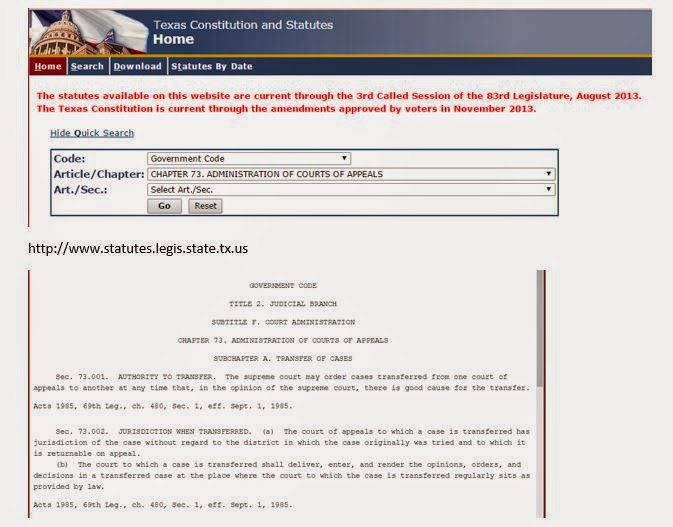
STATUTORY AUTHORITY FOR TRANSFER OF APPEALS AMONG THE COAs


Texas Government Code §73.001 


SAMPLE DOCKET EQUALIZATION ORDER 

http://www.txcourts.gov/media/824209/159022.pdf
Link to the full-length document 
  
 CASELAW SNIPPETS ON TRANSFER OF CASES 

The Texas Supreme Court transferred this appeal from the Court of Appeals for the Fourth District of Texas to this Court pursuant to its docket equalization powers. See TEX. GOV'T CODE ANN. § 73.001 (West 2013) ("The supreme court may order cases transferred from one court of appeals to another at any time that, in the opinion of the supreme court, there is good cause for the transfer."); Order Regarding Transfer of Cases From Courts of Appeals, Misc. Docket No. 14-9121, ¶ II (Tex. June 23, 2014).
--- 
The Supreme Court of Texas transferred this appeal from the Third Court of Appeals in Austin to this Court pursuant to its docket-equalization authority. See TEX. GOV'T CODE ANN. § 73.001 (Vernon 2013) ("The supreme court may order cases transferred from one court of appeals to another at any time that, in the opinion of the supreme court, there is good cause for the transfer.").

IMPLICATIONS FOR APPLICATION OF COA-SPECIFIC CASELAW 

In transferred cases, the receiving court is supposed to follow the binding precedent from the appellate court from which the transferred case originated. TEX.R.APP.P. 41.3. This is significant because the courts of appeal do not always see eye to eye on legal issues, and are not bound to follow each other on legal issues that have not been resolved authoritatively by the court of last resort. A transfer case can put justices in the position of having to depart from thier own precedents to give effect to a prior precedent from a sister court. But that scenario is rare.
Originally appealed to the Twelfth Court of Appeals, this case was transferred to this Court by the Texas Supreme Court pursuant to its docket equalization efforts. See TEX. GOV'T CODE ANN. § 73.001 (West 2013). We are unaware of any conflict between precedent of the Twelfth Court of Appeals and that of this Court on any relevant issue. See TEX. R. APP. P. 41.3.
RELATED TERMS: Docket equalization order, transfer of cases from one court of appeals to another, caseload balancing, transfer in and transfer out, appellate caseloads, number of appeals in each and appellate district, cases per judge.

QUESTION ADDRESSED BY THIS BLOG POST: 
Why do appeals get transferred to a different court of appeals?
Why does the Texas Supreme Court transfer cases from the court of appeal in which they were filed?
Which courts of appeals have cases transferred out and which courts receive them?


Tuesday, March 3, 2015

What is an Interlocutory Appeal?


How fast can a case be appealed in Texas? 

Immediate appeal from a case that is still pending vs appeal after a final judgment is entered. 

INTERLOCUTORY APPEAL

An interlocutory appeal can be defined as an immediate appeal, but that is not a satisfactory definition because other appeals can be “immediate” also, depending on how fast the attorney for an aggrieved client seeks relief in the higher court.

An interlocutory appeal, unlike a regular appeal, is a vehicle to obtain review by a higher court while a case is still pending in the trial court, i.e. there is no final ruling or judgment. In that sense, an interlocutory appeal has more in common with a petition for writ of mandamus, which is typically also filed while a case is still pending (though there are exceptions, such as when a trial court takes action to alter a judgment after the expiration of plenary power).

WHEN AND HOW QUICKLY CAN A CASE BE APPEALED?

Unlike an appellate brief, a notice of appeal has minimal content requirements and can be drafted and efiled in minutes, rather than days. That said, there are distinct deadlines: An interlocutory appeals is an accelerated appeal, and must be filed within twenty (20) days. A notice of appeal from a final judgment is generally due thirty days for the date the judgment is signed (not the date it is rendered); but the deadline can be extended by timely filing one or several post-judgment motions in the trial court instead. (Appeals from JP courts to county courts have different rules).

The distinguishing characteristic of an interlocutory appeal is that it is filed while a case remains pending in the trial court, whereas an ordinary appeal is taken from a final judgment or other case-terminating order.

Either type of appeal could be filed on the day the court below signs an order that one or both parties find fault with, as long as such an appeal is authorized. The question of authority to appeal is a second characteristic that distinguishes an interlocutory appeal from a regular appeal from a final judgment. Final judgments and equivalent orders (e.g., orders of dismissal that also terminate a case, but do not involve an award of money to one or the other) may be appealed as a matter of right as long as they result from a contested proceeding (agreed judgments are generally not appealable), but interlocutory appeals are only permitted if they are authorized by statute.

UNAUTHORIZED APPEALS DO GET FILED, BUT RESULT IN DWOJ

Lack of statutory authorization does not mean such interlocutory appeals will not be filed, but such appeals are subject to being dismissed for lack of jurisdiction without regard to the validity of the legal arguments that the appellant is eager to raise. This happens with some regularity. The clerk of the appellate court will normally send (mail or email) a notice regarding the apparent lack of jurisdiction, and offer the appellant an opportunity to show otherwise, before the court dismissed the appeal. à Dismissal for Want of Jurisdiction (DWOJ). Upon a finding that the court of appeals has no jurisdiction, the appeal is often labeled an “attempted appeal”.

NEW FACTS MAY RENDER AN APPEAL MOOT

There are other bases for jurisdictional dismissal, such as mootness, which may provide the court of appeals with an occasion to consider extrinsic and new evidence that could not otherwise be considered because an appeal is based on the record sent up from the trial court, and does not allow for the introduction of new evidence.

If an appeal becomes moot after the date of the judgment, it may be necessary for the appellate court to look into the facts pertaining to mootness even if they cannot be gleaned from the record on appeal. A common scenario resulting in mootness is an agreement by the parties to the appeal to resolve all issues and disagreements between them. Normally, the appellant will then file an unopposed motion to dismiss, or the parties will file a joint motion to dismiss, or a joint motion to reverse without regard to the merits and to remand for entry of an agreed order of dismissal in the court below, but this does not always happen. The court of appeal may eventually dismiss the case as moot if the court becomes aware of the settlement.

A pending interlocutory appeal may also be rendered moot if the trial court proceeds to trial or final hearing and enters a final judgment. A classic example of this scenario is an appeal of a temporary injunction. A final judgment, or a nonsuit, terminates the temporary order, and therefor eliminates the basis for the appeal.  

If there is new evidence that is material to the propriety of a final judgment, it must be presented to the trial court; either by motion for new trial (if it’s not too late); or in a bill-of-review proceeding, which is a new lawsuit to re-open a case that is too old to be amenable to a regular appeal or a restricted appeal, which can be brought up to 180 days after the judgment under certain circumstances.

‘’PERFECTION” OF APPEAL

In Texas, an appeal from a trial court to the court of appeals is taken, rather than made; and it is said to be “perfected” upon the filing of a notice of appeal. Strangely enough, the notice of appeal is filed in the trial court, and then forwarded to the court of appeals, rather than being filed with the clerk of the court of appeals in the first instance. Nor is the appeal “perfected” in the normal sense of the word, when the notice of appeal is file-stamped. The file-stamp is important as proof of timeliness, but the clerk of the trial court will not even collect the filing fee. If perfected means completed or made ready for the appellate court to rule on the merits, the real work begins after the notice of appeal has been filed; -- though astute attorneys will plan for a possible appeal while the case is still pending in the trial court, particularly when the case involves a lot of money (“amount in controversy”) or is otherwise a high-stakes case.   

HOW AN APPEAL IS INITIATED

The Notice of Appeal itself is a one-page or two-page document. Some attorneys include information about the issues in the case in the notice of appeal, but this is rare. If there were more than two parties in the case, it is particularly important to identify which one is appealing. The court of appeals may or may not grant leave to correct error in the notice of appeal, but if a party wanting to appeal is not even properly identified, it may be too late after the deadline has passed.

The notice is supposed to also identify the court of appeals to which the appeal is taken, but this is a meaningless form requirement because the appellant does not have a choice in the matter; not even in the ten counties in the first and fourteenth appellate district, which are co-extensive. Appeals from those counties are made to either the First or the Fourteenth Court of Appeals, but the assignment is made randomly by the clerk.  

What makes or breaks a timely-filed appeal are the record and the briefs. The record on appeal consists of two records, the Clerk’s Record and the Reporter’s Record.

An appellate brief is mandatory for the party that brings the appeal, and must strictly comply with numerous requirements as to form, format, length, and structure. Noncompliant briefs may be struck, or even rejected when e-filed. The efiling mandate added new requirements, such as searchable text pdf files rather than mere scans of paper documents, and required bookmarks for an appendix consisting of more than a single (i.e., more than the judgment or other order which is being appealed). The appellee is not absolutely required to file a brief, if they think the appeal will be unsuccessful, or do not want to spend the effort and money to prepare one. If they do file a brief, they are subject to the same formal requirements.

The Clerk’s Record, often abbreviated CR or C.R. in the required citations in briefs, is the compilation of papers from case file in the court below. The “papers” are now collated and forwarded electronically as a merged pdf file with bookmarks, rather than assembled into heavy volumes of photocopies of filed documents. Some trial court documents are required by the rules, while the inclusion of others is optional. Clerk in this context means the clerk of the court from which the appeal originates, which could the County Clerk or the District Clerk.

The Reporter’s Record, often abbreviated “RR” or “R.R.” in references to particular pages and lines, is the transcript of the in-court oral proceedings taken down by the Court Reporter. This can be the Official Court reporter of the particular court, or a substitute, or a combination of both. Not all appeals require a court reporter’s reporter, but the absence of one may very well doom an appeal because the court of appeals will assume that the unavailable record supports the judgment.
The classic example of an appeal that does not require a reporter’s record is an appeal of a summary judgment order, which may or may not have been granted following an oral hearing. Many summary judgments are “heard” by submission, meaning that the judge makes a ruling based on what has been filed only, i.e. the motion for summary judgment, the evidence filed in support it (consisting of affidavit(s) and documents) and the response by the non-movant, if any, including any counter-evidence. Even if there is an oral hearing on a motion for summary judgment, the hearing is only for legal argument, i.e. non-evidentiary, and it cannot generally be considered on appeal, because the essence of summary judgment is that it is based on what has been submitted in writing, and does not involve credibility determinations and resolution of contradictory testimony, at least in theory. à Summary judgment proceeding vs trial on the merits. Some attorneys nevertheless have a reporter’s record prepared for a summary judgment appeal, which may make sense if there is an issue as to whether error was preserved on particular evidentiary objections. Unlike federal district courts, trial judges in state courts typically do not explain their rulings on summary judgment motions. They rarely write opinions, and they do not file findings of facts and conclusions of law after a summary judgment order. Texas case law says that such findings are not appropriate in the summary judgment context. For the same reason, a request for findings after a summary judgment does not extend the deadline for an appeal. In order to obtain an extension, a post-judgment motion will be necessary.

Some types of summary judgment orders and similar types of interlocutory orders may be appealed by interlocutory appeal even if they do not resolve the entire case (e.g. denial of a motion to dismiss or jurisdictional plea by a governmental entity), but most rulings on summary judgment motions are not immediately appealable.

DOCUMENTS OUTSIDE THE RECORD ON APPEAL CANNOT BE CONSIDERED 

"The appellate record consists of the clerk's record and, if necessary to the appeal, the reporter's record." Tex. Rule App. P. 34.1. "The burden is on the appellant seeking review to see that a sufficient record is presented to show error requiring reversal." Henning v. Henning, 889 S.W.2d 611, 613 (Tex. App.-Houston [14th Dist.] 1994, writ denied). "[W]e cannot consider documents attached as appendices to briefs and must consider a case based solely upon the record filed." WorldPeace v. Comm'n for Lawyer Discipline, 183 S.W.3d 451, 465 n.23 (Tex. App.-Houston [14th Dist.] 2005, pet. denied). 
STATUTORY AUTHORIZATION OF INTERLOCUTORY APPEALS

There is no one list that comprehensively covers all scenarios in which an interlocutory appeal is authorized. That said, many such appeals fall into one of the categories listed in Section 51.014 of the Civil Practice and Remedies Code (“CPRC”).

List of authorized interlocutory appeal at Tex. Civ.Prac & Rem. Code §51.014
See: Chapter 51 of the Texas Civil Practice and Remedies Code 

AMENDMENT PERMITTING INTERLOCUTORY APPEAL IN ARBITRATION CASES 

In 2009, the Texas Legislature amended the Texas Arbitration Act to permit interlocutory appeals of orders denying motions to compel arbitration pursuant to the Federal Arbitration Act (FAA). See Tex. Civ. Prac. & Rem. Code § 51.016 (West, Westlaw through 2013 3d C.S.); see also CMH Homes v. Perez, 340 S.W.3d 444, 448 (Tex. 2011) (construing section 51.016). If a dispute is subject to the FAA, section 51.016 of the Texas Civil Practice and Remedies Code authorizes interlocutory appeals "to the court of appeals from the judgment or interlocutory order of a district court . . . under the same circumstances that an appeal from a federal district court's order or decision would be permitted by 9 U.S.C. Section 16." Tex. Civ. Prac. & Rem. Code § 51.016. This authorization does not extend to motions that grant a motion to compel.

SHORTER DEADLINE FOR FILING OF NOTICE OF INTERLOCUTORY APPEAL 

In order to perfect an accelerated appeal of an interlocutory order, the party wishing to pursue the appeal is required to file a notice of appeal "within 20 days after the judgment or order is signed." TEX. R. APP. P. 28.1, 26.1(b).

Case snippet: Filing notice of appeal late has dire consequences 

DENIAL OF SUMMARY JUDGMENT GENERALLY NOT APPEALABLE

The denial of a summary judgment motion is generally not appealable even after the case is over, at least not if the case ended with a judgment after a bench trial or a judgment rendered upon the verdict of a jury. This is because the denial of summary judgment does not itself resolve the case, while the trial on the merits does, one way or the other.

By contrast, if a partial summary judgment is granted in the course of pretrial proceedings, it will generally be merged into the final judgment, and may thus become appealable, unless it is supplanted by a subsequent ruling while the trial court retains plenary power. 

A partial summary judgment may dispose of some claims, but not others, and may result in claims against one party being resolved, but leave the claims or defenses of other parties unaffected. Such partial dispositions can be severed from the main proceeding on motion of a party, and can thus be made final for purposes of appeal, while the remainder of the case remains pending in the trial court as an open case.